For founders, owners and senior operators. And the companies they run.
You are not out of capability.You are out of room to use it.
Executive advisor to leaders carrying real consequence. Architect of Capacity OS™. Author of Signal Loss™.
Newsrooms. Boardrooms. Plant floors. Four continents, three languages, twenty years at the executive table. I have watched capable people lose access to their own decisions under load, and I build the structure that gives it back.
I will tell you what I actually see.

Plainly
Stop making excuses.
Stop talking yourself out of why not.
Stop blending into the room until you become the expectation.
Stop calling that being professional.
What leaders become on the other side of load
Capability does not fall.Access to it narrows.
We are told to conform. Told not to play out of tune. Play out of tune anyway and you get labeled: difficult, abrasive, not a team player. So most capable people learn to hold the note everyone else is holding, and they call the holding executive presence.
It is not presence. It is a narrowing you agreed to.
Under sustained pressure, three things erode before any decision gets made: the quality of the signal reaching you, your capacity to hold competing inputs, and your tolerance for the discomfort of deciding. The output still looks fine. That is exactly why nobody catches it, including you.
This is not a willpower problem and I will not treat it like one. It is structural, and structure is the thing I build. The leaders I work with come out the other side with the range back: the call made, the room hearing one position, the consequence watched by the person who owns it.
How I know
I was read by rooms for forty years.Then I learned to control the read.
Kanal 2 in Copenhagen, anchoring the news. Political spokesperson before that. Four continents, three languages, twenty of those years at the executive table, and nine of them running a California people and safety consultancy inside companies under inspection, under claim, and under sale.
Sixty thousand first impressions taught me the mechanism. A room decides what it is receiving before you finish the first sentence. Under sustained load the same thing happens inside a leader. The range narrows before the decision gets made, and nobody in the room sees it, including the person deciding.
The Decision Access Map™ names where the range narrows. Capacity OS™ is the architecture that rebuilds it. Signal Loss™ is the book that explains why it goes unnamed for so long.
- Not mindset work.
- Not accountability check-ins.
- Not motivation, and not encouragement.
- Not another framework to collect and never install.
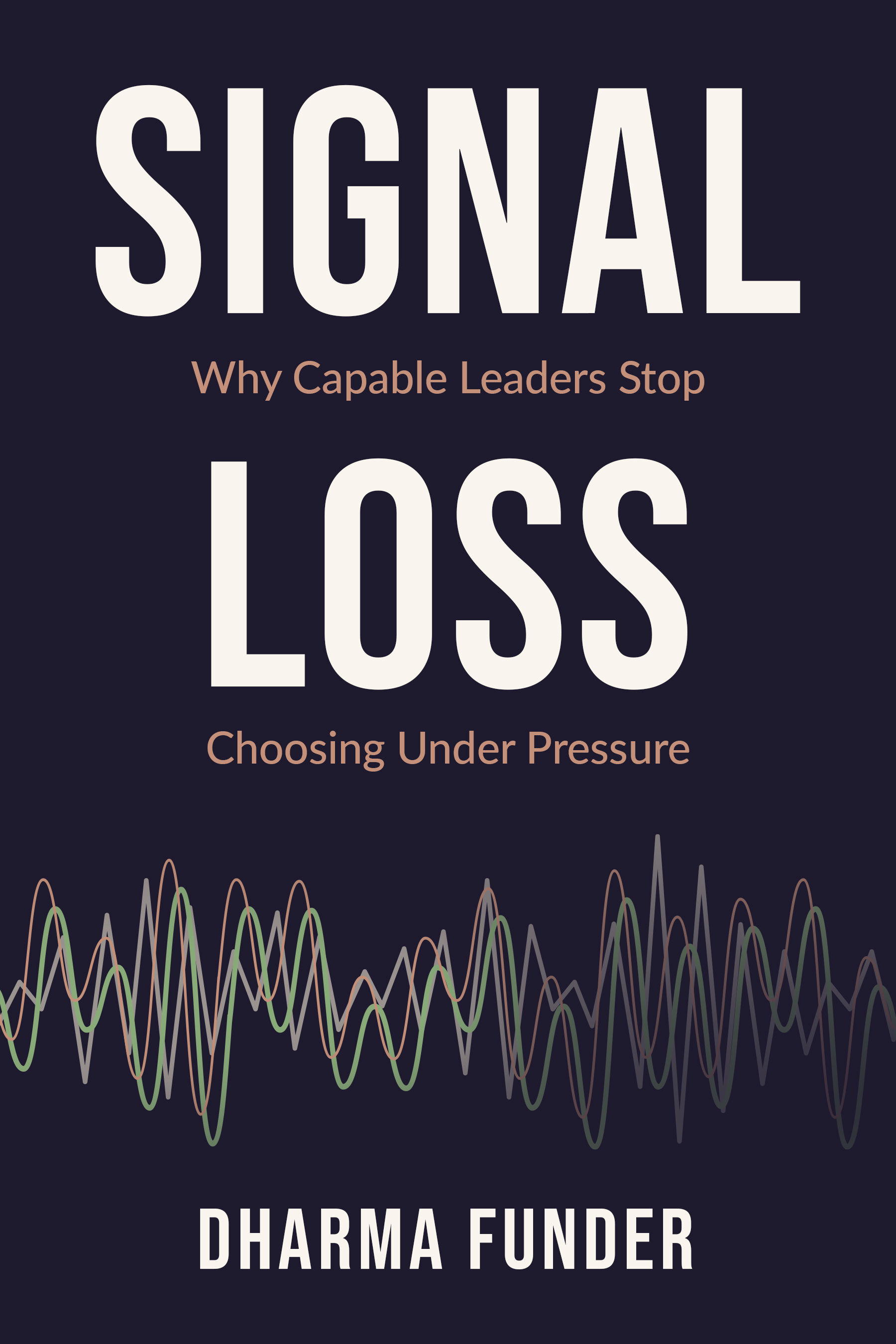
Signal Loss™: Why Capable Leaders Stop Choosing Under Pressure. Paperback, hardcover and Kindle. Order the book
The outcomes
What changes when access comes back.
- OneThe decision that has been sitting gets made. And it holds.
- TwoSimple calls stop taking a weekend.
- ThreeThe leader stops defending choices they would not make again.
- FourThe room hears one position, stated once.
- FiveThe consequence stays with the person who owns it, and gets watched.
- SixThe range comes back before the quarter does.
See it
Signal Loss™, the show. One decision read on camera each week.
No method on display. One problem, located. If you recognise yourself, that is the point.
The decision that is still sitting there
Start here. The one that explains the rest.
Three states you decide from
Full Access, Constrained Access, Pattern Override. Which one you are in right now.
Installed, not attended
“You came to my mind a couple of days ago… thought about calling you, but thinking of what you would advise got me through it… all good now, but many thanks.”
Received as a private message. Shared with permission, name withheld. No client is named on this page, in conversation, or in writing. That is a condition of the work.
Who I work with
Where do you carry it?
Leaders
The person at the top, and the two or three who carry it with them.
Founders, owners, CEOs and senior operators with sustained decision load and real consequence. One to one. Five to eight clients at a time, by introduction. That is the whole advisory practice, and I intend to keep it that way.
Write to me →Companies
Compliance and people functions, installed.
For companies whose exposure sits between departments: the handbook nobody updated, the safety program that exists as a portal link, the people side of a sale. Hybrid. On site across Santa Clara, Santa Cruz, San Mateo and Alameda, remote beyond them. Alongside your people team, never instead of it.
See the corporate practice →Rooms
Owner groups, executive councils, leadership teams.
One talk, delivered to rooms that already carry the weight. Forty-five minutes or a half day. The room leaves knowing which state it is deciding from, and what that is costing. In person across the Bay Area, live video beyond it.
See speaking →The work
Nothing gets installed before it gets mapped.
The Decision Access Self-Check
Twenty questions. They locate your current access state and where you sit on the 30/90/180 Day Erosion Pattern™. It takes minutes. No call attached.
The Decision Access Map™ Workshop
Two and a half hours, live, cameras on. You leave with your own decision structure on paper. Capped at twelve, because every map gets built in the room. Brought to your group, or the next open date.
Private Advisory
One to one, for people carrying sustained decision load. I map where access has narrowed and build what restores range. Inside advisory I take nothing off your desk, because the moment I take the task I have joined the delegation.
Speaking
One talk. Delivered to rooms that carry consequence.
Access Under Load: why leadership fails before results do.
Most leadership breakdowns are misdiagnosed. We assume failure comes from poor judgment, weak character, or a loss of nerve. Under sustained load, leaders do not make worse decisions. They lose access to choice altogether. The talk replaces moral judgment with mechanism: how urgency replaces clarity, how compliance passes for leadership, and why capable people behave predictably under load.
The room leaves with a diagnostic lens it did not have when it sat down. This is not a performance talk. It is an orientation shift, and it is uncomfortable in the useful way.
- The talkForty-five to sixty minutes, with the room's own decisions on the table. Keynote or closing session.
- The roundtableEight to twelve owners or executives, half a day, in person. Each leaves with their own decision read.
- In houseA leadership team, one session, inside the company. Often the first conversation a company has with the corporate practice.
I speak where the room already carries the weight: owner groups, executive councils, member rooms, leadership teams. No slides read aloud. No motivational close.
Before you write
What clients ask first
Is this coaching?
No. Coaching assumes the problem is the person. I work on the structure around the person. No mindset work, no accountability check-ins, no encouragement. If encouragement were the fix, you would already be fixed.
Does this replace HR, Finance, Legal, or an advisor I already have?
No. I advise the people who already own the decision. Most leaders believe they delegated something. They delegated the task and kept the consequence, and nobody was watching the gap between the two. I watch the gap. Your departments keep their jobs. I make sure the decision you are responsible for actually gets made, and that the people you hired follow through.
Is that not what a board is for?
In principle. A board holds leadership to strategy, quarterly. I hold you to specific decisions, at operating cadence, inside the meetings where they actually sit. Most companies I work with do not have a functioning board, and the consequence does not wait for one.
Do you do the work, or advise?
Both exist, never in the same engagement. The corporate practice installs compliance and people functions, on site and remote, and when I am hired to deliver, I deliver. Inside advisory I take nothing, because the moment I take the task I have joined the delegation, and then nobody is watching the gap again.
How does it start?
With an email. Not a form, not a booking link. Tell me the decision that is sitting unmade, how long it has been sitting, and what you have already tried. If you want a read first, the Self-Check at decisionaccessmap.com takes ten minutes.
What does it cost?
The workshop price is on the workshop page. Advisory and corporate pricing is discussed in the conversation, once the decision we are dealing with is on the table. I do not publish it, and I do not discount.
Who will know we are working together?
No one, unless you tell them. Every engagement is confidential. I do not name clients. That is the point.
How do I know this is about access and not just being tired?
Tired resolves with rest. Access does not. If the decisions that used to take a weekend still sit there after the vacation, the problem is structural. The Self-Check will locate it.
It is still sitting there.You know which one.
Write to me. Not a form, not a booking link. An email, to me, and I read it myself. The first conversation is a conversation. We will both know quickly whether this is the right call.
- The decision that is currently sitting unmade.
- How long it has been sitting.
- What you have already tried.
Tell me the real one, not the presentable one.
Decision Access Under Load™. Executive advisory for leaders, compliance and people functions for companies. Santa Cruz, California.